

Mobile vs. Portable Crushing Plants: 5 Key Differences
When upgrading your aggregate production line, choosing the right equipment setup is critical to maximizing your Return on Investment (ROI). While stationary plants are ideal for decades-long operations, contractors and quarry owners increasingly favor flexible solutions. Two of the most popular options are Mobile and Portable crushing plants.
Though often used interchangeably in the industry, these two systems are fundamentally different in their engineering and application:
- Mobile Crushing Plants (Tracked): These are self-propelled machines built on heavy-duty crawler undercarriages. Driven by onboard power units and navigated via wireless remote control, these machines are designed for ultimate agility within the quarry or demolition site.
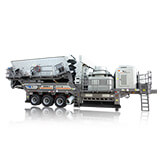
- Portable Crushing Plants (Wheeled): By contrast, these are wheeled units mounted on a semi-trailer rubber-tired chassis. They do not move under their own power; instead, they are towed from site to site by a heavy-duty semi-tractor. They effectively bridge the gap between highly agile tracked units and permanent stationary plants.
While both designs share a massive advantage—eliminating the need for expensive, months-long concrete foundation work—their operational focus is entirely different. In short, mobile plants are tracked for rugged, independent movement within the job site, whereas portable plants are wheeled and towed for efficient highway relocation between different sites.
Treating these two terms as synonyms can lead to a costly mismatch between your machinery and your project’s actual logistics. Here is a deep dive into their 5 primary differences to help you determine which setup will deliver the highest profitability for your operation.

1. Mobility and Propulsion
The most significant tactical difference lies in how and when the plant moves.
- Mobile Crushing Plants (Tracked): Its greatest advantage is extreme in-pit mobility. It can easily navigate steep, rugged, and muddy terrain. As the blasting face advances, a tracked crusher can literally crawl along right behind the excavator. This completely eliminates the need for a fleet of dump trucks hauling raw rock from the pit face to the crusher—saving massive amounts of diesel and labor.
- Portable Crushing Plants (Wheeled): These units are generally not moved around the pit on a daily basis. Their core advantage is highway transportability. Once an excavation or demolition job is finished at one site, the plant can be quickly hitched to a semi-truck and hauled over public highways to the next project.

2. Setup Time and Infrastructure
Time is money, especially for contractors on tight deadlines.
- Mobile Crushing Plants (Tracked): Features true "plug-and-play" functionality. Once unloaded from the lowboy trailer, a tracked plant can drive itself to the exact working spot, unfold its hydraulic conveyors, and begin crushing within 30 minutes. It requires practically zero ground preparation.
- Portable Crushing Plants (Wheeled): Requires moderate site preparation. Because it sits on tires and hydraulic stabilizing legs, the ground must be relatively flat, compacted, and stable. Setting up the hydraulic jacks, connecting the external power supply, and aligning the primary, secondary, and screening chassis can take anywhere from a few hours to a couple of days.

3. Power Supply and OPEX
How the equipment gets its power drastically affects your Operating Expenditure (OPEX) and cost per ton.
- Mobile Crushing Plants (Tracked): Typically powered by an onboard diesel engine that drives a hydraulic system (or an onboard generator). This makes them 100% self-sufficient, which is perfect for remote greenfield sites with no grid infrastructure. However, over the long term, running and maintaining a diesel-hydraulic system is generally more expensive than using grid power. (Note: Dual-power hybrid tracked models are becoming more common).
- Portable Crushing Plants (Wheeled): Mostly engineered as all-electric plants. They do not carry a complex diesel engine on the chassis. Instead, they plug directly into the local municipal power grid or run off a single, large, separate diesel generator (genset) positioned away from the dust. Running on grid electricity significantly lowers the OPEX and reduces maintenance frequency.
4. Cost and Production Capacity
- Mobile Crushing Plants (Tracked): The integration of crawler tracks, remote controls, and onboard power plants makes tracked crushers technically complex. Consequently, for the exact same crushing capacity, their Capital Expenditure (CAPEX) is generally 20% to 30% higher than a wheeled plant. Furthermore, due to the weight limits of the tracks, they are usually restricted to low or medium capacities (up to 300-400 TPH).
- Portable Crushing Plants (Wheeled): Because you aren't paying for an expensive crawler undercarriage and onboard engine, your investment goes directly into a larger crushing chamber. You get higher TPH (Tons Per Hour) capacity for less CAPEX. For large-scale infrastructure projects, it is very common to deploy wheeled portable plants processing 500+ TPH.
5. Maintenance Complexity & Circuit Customization
- Mobile Crushing Plants (Tracked): The design is highly compact. While this provides unmatched mobility, it means the internal working space is very tight. Replacing large wear parts or servicing the complex hydraulic drive system often requires specialized technicians. Additionally, the highly integrated nature of the machine makes it difficult to reconfigure the crushing circuit later on.
- Portable Crushing Plants (Wheeled): The chassis offers more space, closely resembling the layout of a stationary plant. Maintenance crews have wider walkways and platforms for daily inspections. More importantly, wheeled plants offer incredible modular customization. You can easily mix and match a jaw crusher trailer, a cone crusher trailer, and an independent screen trailer like building blocks. You can even add or remove specific washing or screening modules later if your material properties change.
Which is Right for You?
Choose a Mobile Crushing Plant if:
- You are an earthmoving or demolition contractor moving to a completely new site every few weeks or months.
- Your site features rugged, uneven, or soft terrain.
- You want to place the crusher directly at the rock face to eliminate haul truck costs.
- There is absolutely no electrical grid access at your sites.
Choose a Portable Crushing Plant if:
- You are a quarry owner opening a new site for a medium-term campaign (2 to 5 years).
- You need high production capacity (300-600+ TPH) but want to avoid the months of civil engineering and permitting required for a permanent stationary plant.
- You have access to cheap, reliable industrial grid electricity.
- Your site is relatively flat, and the plant will stay parked in one spot for several months at a time.
FAQ: Mobile vs. Portable Crushing Plants
Q1: What is the main difference between mobile and portable crushing plants?
A: The primary difference lies in the chassis. Mobile crushers are equipped with tracks (crawler-type) for self-propelled movement on-site, making them ideal for complex terrains. Portable crushers are mounted on wheels (trailer-type) and must be towed by a truck between sites.
Q2: Which type is more cost-effective for my project?
A: Generally, portable (wheeled) plants offer a lower initial investment, making them the most cost-effective choice for long-term projects at a fixed site. Mobile (tracked) plants, while having a higher upfront cost, provide significant savings in labor and relocation time for projects that move frequently.
Q3: Do these plants require concrete foundations?
A: No. Both mobile and portable designs are engineered for rapid deployment. They eliminate the need for expensive and time-consuming concrete foundations, allowing you to start production almost immediately upon arrival.
Make the Right Move for Your Profitability
Choosing between tracked and wheeled equipment dictates your logistics, maintenance schedule, and ultimately, your cost per ton. Do not rely on guesswork for your next major capital investment.
At our engineering department, we look past the brochures to calculate your true Total Cost of Ownership (TCO).