

How to Design a 100-150tph Soft Rock Crushing Plant?
Soft rock materials—such as limestone, dolomite, sandstone, and marble—represent some of the most commonly processed aggregates in the construction industry. With typical hardness ranging from 3 to 5 on the Mohs scale, these materials offer distinct advantages in crushing plant design: lower energy consumption, reduced wear part costs, and higher throughput compared to hard rock applications.
The 100-150tph soft-rock crushing plant is a core solution for processing low-to-medium hardness minerals such as limestone, gypsum, dolomite, and sandstone, widely applied in construction aggregate production, mining beneficiation, and infrastructure projects.
This article provides a comprehensive guide to designing a 100-150 tph soft rock crushing plant, covering equipment selection, circuit configuration, layout optimization, and operational considerations.

1. Understanding Your Feed Material
1.1 Characteristics of Soft Rock
Before designing any crushing plant, thorough material characterization is essential. Soft rock typically exhibits:
| Property | Typical Range | Design Implication |
|---|---|---|
| Compressive Strength | 30-150 MPa | Lower crushing force required |
| Abrasion Index | < 0.1 | Reduced wear part consumption |
| Moisture Content | 2-10% | May affect screening efficiency |
| Clay Content | Variable | May require washing or scalping |
1.2 Why Soft Rock Favors Impact Crushing
For hard, abrasive rocks, engineers rely on Jaw and Cone crushers (compression crushing) to save on wear parts. However, for soft rock, Impact Crushers are the undisputed champions.
Impact crushers strike the rock at high speeds, breaking it along its natural cleavage lines. This method offers two massive advantages for soft rock:
- Superior Particle Shape: It produces highly uniform, cubical aggregates with zero flaky or elongated pieces, perfect for premium concrete and asphalt.
- High Reduction Ratio: A single impact crusher can often do the work of two compression crushers, allowing you to shorten the production line and save on equipment costs.

2. Project Overview and Design Principles
2.1 Basic Parameters and Application Scenarios
The plant is designed for a processing capacity of 100-150 tons per hour, targeting soft rocks with a compressive strength below 150MPa. The raw material feed size is ≤500mm, and the finished products are classified into standard construction aggregate specifications (0-5mm, 5-10mm, 10-20mm, 20-40mm) to meet the requirements of road construction, concrete mixing, and building materials production. The design must comply with international mining and construction machinery standards, focusing on safety, energy efficiency, environmental protection, and operational flexibility.
2.2 Core Design Principles
- 1. Capacity Matching: The processing capacity of each equipment unit must be matched to ensure the overall plant operates at a stable 100-150tph without bottlenecks.
- 2. Material Adaptability: Optimize the process for soft rocks to reduce equipment wear and ensure finished product particle shape quality.
- 3. Economic Efficiency: Minimize total ownership cost (TOC) through reasonable equipment selection and layout, while maximizing return on investment (ROI).
- 4. Safety and Environmental Protection: Comply with dust suppression, noise reduction, and occupational safety regulations for mining and crushing operations.
- 5. Operational Maintainability: Adopt modular design and easy-to-maintain equipment to reduce downtime and maintenance costs.
3. Process Flow Design
The 100-150tph soft-rock crushing plant adopts a two-stage crushing + single-stage screening closed-circuit process, which is the most mature and cost-effective configuration for soft-rock processing. The entire process is divided into five core stages: raw material feeding, primary crushing, secondary crushing, material screening, and finished product stockpiling.
3.1 Process Flow Chart
Raw Material (ROM, ≤500mm) → Vibrating Feeder → Jaw Crusher (Primary Crushing) → Belt Conveyor → Impact Crusher (Secondary Crushing) → Belt Conveyor → Vibrating Screen (Classification) → Finished Product Stockpiles (0-5mm/5-10mm/10-20mm/20-40mm); Oversized material returns to the impact crusher for re-crushing.
3.2 Process Advantages
- 1. High efficiency: The two-stage crushing process ensures the material is fully crushed, meeting the capacity target of 100-150tph.
- 2. Low wear: Impact crusher is ideal for soft rocks, reducing liner wear compared to cone crushers, lowering maintenance costs.
- 3. Closed-circuit screening: Recycles oversized materials, improving material utilization and finished product yield.
- 4. Simple operation: The process flow is concise, easy for operators to master, and suitable for long-term stable operation.
4. Core Equipment Selection and Configuration
The plant’s core equipment includes jaw crusher, impact crusher, vibrating screen, and auxiliary equipment (vibrating feeder, belt conveyor). The selection is based on capacity matching, material characteristics, and operational stability.

4.1 Feeding and Primary Crushing
Vibrating Feeder: A robust grizzly vibrating feeder is essential. The "grizzly" bars will screen out the natural dirt and undersized fines before they enter the primary crusher, improving overall efficiency.
Primary Jaw Crusher: Even for soft rock, a Jaw Crusher (typically a model with a feed opening around 600x900mm) is used as the primary breaker to handle large run-of-mine (ROM) boulders up to 500mm, reducing them to manageable sizes (10-15cm) for the secondary stage.
Core Advantages:
- 1. Robust structure: Heavy-duty cast steel frame and reinforced moving jaw ensure stable operation under long-term heavy load.
- 2. Wide adaptability: Handles soft rocks with low abrasiveness, reducing equipment failure rate.
- 3. Easy maintenance: Simple structure, convenient replacement of wear parts (jaw plates), and low maintenance cost.
- 4. High reduction ratio: Effectively reduces large boulders to a size suitable for secondary crushing.
4.2 Secondary Crushing and Shaping
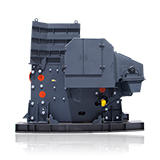
The impact crusher is the core of the secondary crushing stage, responsible for crushing coarse materials (≤150mm) into medium-sized particles (≤50mm) and optimizing the particle shape of finished aggregates. A PF series impact crusher (e.g., PF1210) is selected, with a capacity of 100-180tph, matching the jaw crusher and meeting the plant’s capacity requirements.
Core Advantages:
- 1. Ideal for soft rocks: Utilizes impact force for crushing, avoiding excessive wear of equipment parts, and is more cost-effective than cone crushers for soft materials.
- 2. Excellent particle shape: Produces cubic aggregates with low needle-like content, meeting high-quality construction aggregate standards.
- 3. High crushing efficiency: Fast material processing speed, ensuring the plant’s continuous and stable operation.
- 4. Hydraulic opening design: Facilitates quick maintenance of internal parts, reducing downtime.
4.3 Screening and Separating
Vibrating Screen: A multi-deck circular vibrating screen (e.g., a 3-deck or 4-deck screen) classifies the crushed stone into your desired final sizes—typically 0-5mm (sand), 5-10mm, 10-20mm, and 20-31.5mm.
Core Advantages:
- 1. High screening efficiency: Circular vibration trajectory ensures uniform material stratification and accurate classification.
- 2. Closed-circuit design: Recycles oversized materials back to the impact crusher, improving production yield.
- 3. Durable structure: Heavy-duty screen frame and wear-resistant screen mesh extend service life.
- 4. Low noise: Equipped with vibration damping devices, meeting environmental noise control standards.
4.4 Auxiliary Equipment
- Vibrating Feeder: GZD series electromagnetic vibrating feeder, used for uniform and quantitative feeding of the jaw crusher, avoiding material blockage and ensuring stable operation of the primary crushing stage.
- Belt Conveyor: Heavy-duty rubber belt conveyors with wear-resistant belts and tensioning devices, responsible for material transportation between each equipment unit, with a conveying capacity matching the plant’s total capacity.
- Dust Suppression System: Bag dust collectors and spray dust suppression devices to control dust emission during crushing and screening, complying with environmental protection regulations.
5. Plant Layout Design
The layout design directly affects the plant’s operational efficiency, maintenance convenience, and land use efficiency. The 100-150tph soft-rock crushing plant adopts a linear horizontal layout with a compact structure and reasonable process flow.
5.1 Layout Principles
- Process Continuity: Arrange equipment in the order of the process flow to minimize material transportation distance and reduce energy consumption.
- Space Optimization: Maximize land use efficiency, with a total plant area of about 800-1000㎡ (length × width: 40m × 25m).
- Maintenance Access: Reserve sufficient maintenance space around each equipment unit, especially for the jaw crusher and impact crusher.
- Safety Distance: Maintain safe operating distances between equipment and between equipment and walkways, complying with occupational safety standards.
- Environmental Adaptability: Arrange dust suppression and noise reduction equipment in areas with high material flow to minimize environmental impact.
5.2 Detailed Layout Arrangement
- Raw Material Yard: Located at the front end of the plant, adjacent to the vibrating feeder, for stacking raw materials and facilitating feeding.
- Primary Crushing Zone: Jaw crusher and vibrating feeder are arranged in the first zone, with a dedicated walkway and maintenance platform.
- Secondary Crushing Zone: Impact crusher is arranged behind the jaw crusher, connected by a belt conveyor, with a material return channel for closed-circuit screening.
- Screening Zone: Vibrating screen is arranged in the middle of the plant, with finished product stockpiles on both sides for easy loading and transportation.
- Auxiliary Zone: Dust suppression systems, electrical control rooms, and maintenance workshops are arranged at the rear of the plant, away from the core crushing area to reduce noise and dust interference.
6. Auxiliary System Configuration
6.1 Electrical Control System
Adopt a PLC automatic control system with remote monitoring function, which can realize the start/stop of each equipment unit, real-time monitoring of operating parameters (current, vibration frequency, material level), and fault alarm. The system supports manual and automatic modes, improving operational intelligence and reducing labor costs.
6.2 Power Supply System
Configure a dedicated power distribution cabinet with overload protection, short-circuit protection, and voltage stabilization functions to ensure the stable operation of all equipment. The total power consumption of the plant is about 150-200kW, which can be connected to the local power grid or equipped with a backup generator set for off-grid operation.
6.3 Environmental Protection System
- Dust Control: Install bag dust collectors at the feeding port, crushing chamber, and screening station to collect dust, with a dust removal efficiency of over 99%.
- Noise Reduction: Equip equipment with sound insulation covers and vibration dampers, reducing the operating noise of the plant to below 85dB(A).
- Wastewater Treatment: Collect and treat washing wastewater (if applicable) through a sedimentation tank, realizing recycling and zero discharge.
6.4 Safety System
Each equipment unit with emergency stop buttons and safety guards to prevent personal injury. Set up fire extinguishing devices in the electrical control room and equipment operation area. Configure walkways, handrails, and warning signs to ensure safe access for operators.
The design of a 100-150tph soft-rock crushing plant is a systematic project that integrates process flow, equipment selection, layout planning, and auxiliary system configuration. By adopting a two-stage crushing + single-stage screening process, matching jaw crusher, impact crusher, and vibrating screen reasonably, and optimizing layout and auxiliary systems, the plant can achieve stable operation, high efficiency, low cost, and environmental protection. This design scheme is highly adaptable to soft-rock processing projects such as limestone and gypsum, and can be adjusted and optimized according to actual material characteristics, site conditions, and market demand, providing a reliable solution for medium-scale aggregate production projects.